Emission Monitoring and Gas Analysis
Browse these categories under "Emission Monitoring and Gas Analysis"
SKU : BBD6-4100
The BBD6 utilises AC Coupled Triboelectric technology. As particles travel through
the process they develop a charge. This charge is transferred as the particle passes or impacts the sensing element. The resulting current is
amplified, filtered, rectified and further filtered looking only at the AC component, giving a linear representation of the concentration or mass flow
rate of the particles in the gas stream. The reason for measuring the AC component is that, compared to the DC component, the electronics are more
sensitive. The AC signal is substantially less affected by influences such as amplifier noise and process parameters, which includes the build-up of
process dust on the sensing rod. The BBD6 remote sensing head totally filters out any 50 Hz or 60 Hz frequencies related to mains supply. The
amplified signal is then sent via data cable to the control unit for further processing and display.
SKU : EMP6-3100
The EMP6 utilises AC Coupled Triboelectric technology. As particles travel through
the process they develop a charge. This charge is transferred as the particle passes or impacts the sensing element. The resulting current is
amplified, filtered, rectified and further filtered looking only at the AC component, giving a linear representation of the concentration or mass flow
rate of the particles in the gas stream. The reason for measuring the AC component is that, compared to the DC component, the electronics are more
sensitive. The AC signal is substantially less affected by influences such as amplifier noise and process parameters, which includes the build-up of
process dust on the sensing rod. The EMP6 remote sensing head totally filters out any 50 Hz or 60 Hz frequencies related to mains supply. The
amplified signal is then sent via data cable to the control unit for further processing and display.
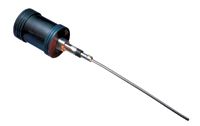
SKU : EMP7-3200-CSA
The EMP7 utilises ISE technology. Each particle travelling through the process
develops an electrical charge. As the particle passes or impacts with the sensing element, a current is induced which is processed in EMP7 by a method
called Impulse Signature Extraction ("ISE"). ISE technology extracts the basic characteristics (the "signature") of the impulsive signals induced by
individual particles in the gas stream. Since these characteristics are related to such things as the particle velocity, EMP7 is able to compute
velocity as a parameter, and therefore to calculate the emission level as either mass flow rate or mass density as required. In addition, although ISE
technology processes the entire signal from the sensing element, its algorithm effectively negates the potentially erroneous effects of the DC
component of the signal, so ISE technology shares all the advantages of existing AC Triboelectric technology. Made a reality by recent advances in low
power digital signal processing, ISE technology is as significant a step forward now as the introduction of AC Triboelectric technology was in
1992.
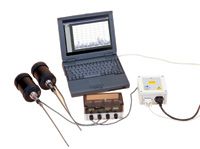
SKU : EMS6-3200
The EMS6 utilises AC Coupled Triboelectric technology. As particles travel through
the process they develop a charge. This charge is transferred as the particle passes or impacts the sensing element. The resulting current is
amplified, filtered, rectified and further filtered looking only at the AC component. This gives a linear representation of the concentration or mass
flow rate of the particles in the gas stream, depending on the chosen scale of calibration. The reason for measuring the AC component is that,
compared to the DC component, the electronics are more sensitive. The AC signal is substantially less affected by influences such as amplifier noise
and process parameters, which includes the build-up of process dust on the sensing rod. The EMS6 totally filters out any 50 Hz or 60 Hz frequencies
related to mains supply. The digital signal is then sent via a data cable to PLC, SCADA or a Connect Network System. The EMS6 linear representation of
concentration or mass flow has been validated by independant laboratories. The EMS6 along with ANJ1, ANP1 and Connect software has been tested and
certified for monitoring dust emissions according to the "MCERTS" standard.